Tuesday, March 4, 2025

ENST Soil and Watershed Science Scholarship, supported by Larry and Ann Strickling

Hi ENST Undergraduate students

We are pleased to announce the ENST Soil and Watershed Science Scholarship, supported by Larry and Ann Strickling, for 2025.

Dr Edward Strickling was a soil science faculty member in our department, with a long and distinguished record of service https://www.washingtonpost.com/archive/local/2007/03/25/obituaries/11430950-ed92-4423-8543-b8bbf73707c6/

Eligibility and criteria details are given below, and the application form is attached.

Eligibility for the ENST Soil and Watershed Science Scholarship, supported by Larry and Ann Strickling:

Students must meet the minimum criteria:

  1. ENST must be the primary undergraduate major;
  2. Must be a currently enrolled student in good standing; and,
  3. Must have at least one semester left on their degree program.

Available to current undergraduate ENST students who have completed or currently are enrolled in ENST 200 and at least one additional soil science course and have expressed an interest in a Soil and Watershed Science major or conducting a minor in soil science.

Criteria:
  • Candidates should have a strong interest in pursuing a career in Soil and Watershed Science as demonstrated by enrollment in or successful completion of soil science classes, and through such activities as being employed or having an internship related to soil science, engaging in special soils related research projects, participation on the soil judging team, etc.
  • Competitive recipients should demonstrate strong academic performance overall and within Soil and Watershed Science courses as well as team and leadership skills.

Please consider applying.

The application deadline is Friday, March 14, 2025.

The application form can be found here

Thanks and best wishes to you for the Spring semester.
Wildlife Monitoring Internship [Smithsonian]

Wildlife Monitoring Internship 2025

The Smithsonian’s National Zoo and Conservation Biology Institute (SNZCBI) is seeking an intern to assist with multiple projects related to conservation technology for wildlife monitoring. SNZCBI scientists collect data on wildlife and natural ecosystems globally using sensors such as camera traps, GPS collars, and remote sensing. As wildlife data becomes increasingly digital, we require robust technology systems to ensure long-term access and sustainability.

To support Smithsonian staff members engaged in biodiversity monitoring, we are hiring an intern to assist with two key programs focused on camera trap and GPS collar data.

Program Areas
  1. Digital Biodiversity Collection
    The Smithsonian is establishing its first ‘born digital’ collection—a high-quality, publicly accessible database of camera trap images chronicling the distribution, abundance, and species richness of wildlife over time. This collection will include datasets from the annual Snapshot USA survey and other related projects and will involve machine learning via the Wildlife Insights platform, participatory science via Zooniverse.org, and data science techniques.
  2. Wildlife Movement Data & Conservation Indicators This initiative focuses on developing quantitative metrics and indicators from GPS tracking and remote sensing data to inform biodiversity conservation. The project integrates movement data into conservation indicators, bridging the gap between ecological research and practical conservation strategies at local and global scales.

Intern Responsibilities
The intern will work closely with two Smithsonian staff members:

The Digital Collections Manager – supporting data curation, quality control, metadata corrections, and project setup for Wildlife Insights and Zooniverse.
The Quantitative Ecologist – assisting with analysis of GPS tracking data, camera trap images, and satellite imagery.

Specific tasks include:

  • Identifying and quality-checking incoming data
  • Correcting metadata and classification errors
  • Transferring data between platforms and setting up projects in Zooniverse
  • Engaging with volunteers and community scientists
  • Analyzing diverse ecological datasets
  • Developing data wrangling skills in R, Python, and JavaScript

This internship offers valuable hands-on experience at the intersection of ecology, conservation technology, machine learning, and community science.

Qualifications
Required Qualifications
  • Current or recently graduated undergraduate or graduate student in ecology, wildlife biology, conservation biology, environmental science, or a related interdisciplinary field.
  • Ability to accurately classify species and behaviors in camera trap images.
  • Interest in camera trap, GPS collars, wildlife monitoring research, and/or plans for a career in wildlife biology/conservation.
  • Experience or aptitude in acquiring, manipulating, and managing spatial data, including digitizing maps/images, creating maps, and performing basic spatial analysis.
  • Demonstrated qualitative, quantitative analysis and critical thinking skills.
  • Excellent learning skills and attention to details.
  • Excellent written and oral communication skills.
  • Ability to work both collaboratively and independently.
Desired Qualifications
  • Experience with managing, maintaining, and populating relational databases.
  • Experience with Zotero, EndNote, or other reference management software.
  • Experience with statistical analysis (R, Python, SAS, etc).
  • Experience with spatial data acquisition, storage, administration, and management functions via ArcGIS, ENVI, QGIS, and/or R; and/or remote sensing analysis via Google Earth Engine.
  • Experience working closely as a team, managing multiple projects and prioritizing tasks from multiple sources and deadlines.
  • Experience conducting field surveys in conservation or wildlife biology.
Location
  • This internship will comprise mostly office work and will be in-person at the Smithsonian Conservation Biology Institute in Front Royal, VA.
  • The intern will be part of a cohort of interns at the Center with regular meetings and additional opportunities to interact with fellow interns and researchers.
Compensation

This position will be supported by a $1500/month stipend and optional $9/day on-site housing in a communal dorm. The internship will be approximately 6 months, with a start date in May and end date in November, with the option for an additional 6-month renewal.

To Apply:
  • Applications deadline is March 14, 2025.
  • Interested applicants should submit a cover letter, resume, and contact information for three references as a single PDF, named “Internship_Your Last Name.pdf” to both Sarah Huebner (huebners2@si.edu) and Weiqian Gao (gaow@si.edu).
  • Please include your last name and “Wildlife Monitoring Internship” in the title of your email.
  • Cover letter should include:
    • Statement of interest.
    • Potential start date and the duration of time you are available for the internship.
    • Elaborate on your programming experience and skill as much as possible.
  • Due to the high volume of applications received, we are unable to contact each application individually regarding the application status.

Internships and Opportunities with the Office of Sustainability

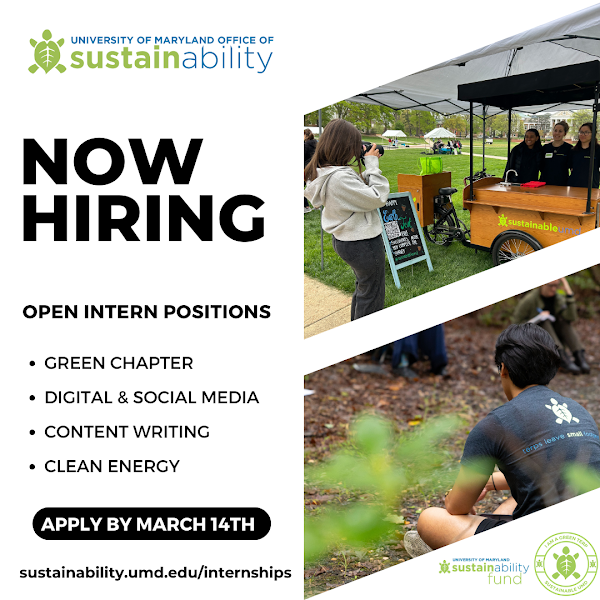
The Office of Sustainability is Hiring!

Hello Green Terps! Are you looking for professional development opportunities and aiming to work in sustainability? Apply for an internship or volunteer position with the Office of Sustainability to enhance your skill set. Learn more about the opportunities below and help foster UMD’s sustainability culture.


Internship Cohort Application

The Office of Sustainability is excited to announce that applications for our 2025-2026 student internship cohort are now open! These are one-year, paid positions for students enrolled in the fall 2025 and spring 2026 semesters. The positions and their descriptions can be found on our website.

Applications are due by Friday, March 14th, 2025 at 11:59 pm.


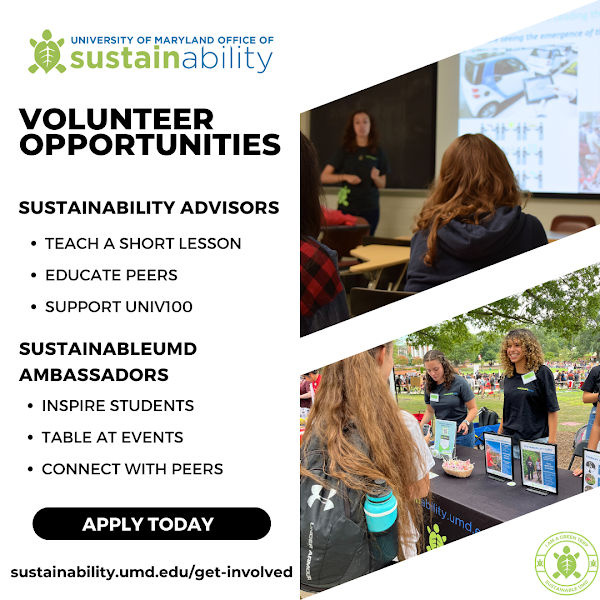
Ambassador and Advisor Volunteers

Are you passionate about sustainability but do not have time for an internship? Join our two volunteer teams, the Sustainability Advisors and SustainableUMD Ambassadors. Sustainability Advisors teach an interactive lesson to first-year students about sustainability and climate change and how each affects students, their studies, and future career prospects. SustainableUMD Outreach Ambassadors conduct outreach to connect students with campus sustainability resources, programs, and initiatives.

Applications are accepted on a rolling basis until Monday, April 24th at 11:59pm.

MD Stream Restoration Association Scholarship - Due April 4

Jim Gracie Memorial Scholarship Application - 2025

The Maryland Stream Restoration Association (MSRA) is seeking applications for the Jim Gracie Memorial Scholarship. Jim was a pioneer in stream restoration and cold-water conservation in Maryland. He grew up in Baltimore and was an avid fly fisherman as well as a founding member and past president of the MSRA. For over four decades he devoted his time, energy, and work towards policy, education and outreach, and industry growth in expanding stream restoration and improving our watersheds.

The Jim Gracie Memorial Scholarship for 2025 is open to all students pursuing degrees or training in fields promoting natural resource preservation, stream restoration, and the environmental sciences.

Preference will be given to those with diverse perspectives residing in Maryland and Virginia. Applicants should be able to show and demonstrate their passion for nature and the natural environment and should be enrolled in a degree seeking program or training program for these fields. The successful applicant should be able to articulate in their application how they connect with the environment, how their passion and study aligns with the values exhibited by Jim, and how receiving a scholarship award will help in achieving their academic and career goals.

The successful applicant, in addition to the scholarship award, will also receive a complementary 1-year membership with the MSRA; this will allow for networking, webinar series access, and field trips for continued access within the stream restoration industry.

Scholarship application link is here!!! Good luck

Save Soil Movie Screening: "Common Ground" (March 12) - be sure to register!

Save Soil is launching Cultivating Change: Save Soil Movie Event (featuring Common Ground film) to raise awareness in our community about the soil degradation crisis and how we can be part of the solution. Cities around the globe will be hosting an event featuring a film titled Common Ground, produced and directed by Kiss The Ground organization. This event will be free and open to the public.

To register and for more information: https://Save-Soil-Movie-Event-Cultivating-Change-Maryland-UMCP.eventbrite.com

[AGNR-UNDERGRADSTUDENTS] Last Call: Present at Discovery & Innovation Night!

Join us on April 10, 2025 for the annual AGNR Discovery and Innovation Night! This signature event brings together AGNR students, faculty, staff, alumni, and industry professionals for an evening of connecting. This program will feature the student experience showcase: an opportunity for students to show off and highlight the impactful experiences they have taken advantage of outside of the classroom (think internships, study abroad, research, etc.).

The deadline to sign up to present is March 10!

For more information on what participating as a presenter at the AGNR Discovery & Innovation Night will look like, check out this FAQ. Photos and a short video from previous Discovery and Innovation Nights can be found here.

Don’t think you want to participate in the showcase this year? That’s completely fine! Consider attending to see what other students have done and connect with alumni and employers to learn about more opportunities.

Student Attendee Registration: https://go.umd.edu/DINstudent25
Presenter Interest Form: https://go.umd.edu/DIN25present

Center for Agro-Ecology Updates

Upcoming Events


Tackling Hunger Together: An Eastern Shore Food Security Symposium - Tuesday, March 18

Join the Eastern Shore Food Coalition from 8 a.m. to 3:15 p.m. on Tuesday, March 18, at Tackling Hunger Together: An Eastern Shore Food Security Symposium at Chesapeake College, 1000 College Circle, Wye Mills, Md.

The symposium will be a day filled with insightful discussions, engaging workshops, and networking opportunities. Attendees will explore innovative solutions to address food insecurity in their communities.

The keynote speaker is LaMonika Jones, Director of State Initiatives at the Food Research and Action Center, where she oversees D.C. Hunger Solutions, Maryland Hunger Solutions, and the New Jersey Food Security Initiative. The speaker for lunch is Kim Hines, co-director of the North American Food Systems Network. Hines’ interest involves national trends in local and regional food systems employment to assess, create, and deliver training and tools for an evolving, place-based workforce. She contributed to the creation of the Community Agriculture Resilience Audit Tool (CARAT) as well as the AgriCluster Resilience and Expansion (ACRE) training, both recently utilized in Maryland.

This event is free, and both breakfast and lunch will be provided. You can register and find the full agenda here: https://easternshorefoodsecurity.eventbrite.com/

Background: The Eastern Shore Food Coalition is a grassroots group of dedicated partners who aim to spark positive change and motivate action among those involved in food security. This inaugural symposium event is designed to catalyze future progress. Partners include MidShore Meals til Monday, Harry R. Hughes Center for Agro-Ecology, Chesapeake Agricultural Innovation Center, the Mid Shore Health Improvement Coalition, Caroline County Public Schools, Talbot Family Network, Food pantries, Local Management Boards and more.

March Webinar to Highlight Triticale Genetics Research - Tuesday, March 25

The Hughes Center is kicking off its 2025 webinar series with a presentation featuring UMD College of Agriculture and Natural Resources Associate Professor Dr. Vijay Tiwari and his research on gene editing in triticale cultivars.

Changing climatic conditions, increased pressure from biotic stresses and reduction in agricultural land pose significant global challenges for crop production. As a result, there is an urgent need to focus on developing resilient cereal crops that require low input and can fulfill the needs of grain, forage, feed and cover crops. Dr. Tiwari will present on why triticale is a great fit for these requirements. His project aims to deliver efficient, modern, locally adapted triticale cultivars that can be used as the cool season cover crop for Maryland and the broader Mid-Atlantic region. This project is funded by the Hughes Center for Agro-Ecology.

Dr. Tiwari’s research is focused on genetics and genomics of small grain crops with emphasis on wheat, rye and barley, specifically, integrating genomic tools and germplasm development to achieve the goals of sustainable agriculture. Another important aspect of Tiwari’s research is a focus on molecular understanding of yield and yield contributing factors in bread wheat.


Science Communications and Outreach Internship Available for Summer 2025

The Harry R. Hughes Center for Agro-Ecology is seeking one University of Maryland student for a summer internship that offers an opportunity to work with an environmental and agricultural nonprofit organization. The Hughes Center is affiliated with the University of Maryland College of Agriculture and Natural Resources and is located at the Wye Research and Education Center in Queenstown, Maryland. This internship is based online with occasional in-person meetings (at least twice but up to four times throughout the 8-week internship) and travel to research site locations for video shoots. Access to reliable transportation is required.

This internship focuses on communications and outreach, specifically with an eye on video content creation and graphic design. The intern will learn how the Hughes Center's projects and scientific research interact with the state's agricultural and environmental sustainability and conservation goals and learn to communicate messages on scientific topics to lay audiences. This internship will provide the opportunity to learn and practice various aspects of public outreach, content creation and distribution, and analytics. The chosen intern will work directly with the Hughes Center's communications coordinator to develop and execute content plans for the Center's research and projects.

Duties and expectations:
  • Video Content Creation: The intern will work with the Center's Communications Coordinator to plan, shoot and edit short and long-format video content based on the Hughes Center's research projects and partnerships. The ideal candidate is creative, adept with a camera and familiar with video editing software. The videos will be used to grow our YouTube page, social media, and website and newsletter article support. Examples of the Hughes Center's outreach videos can be found here.
  • Graphic Design: The intern will help update the Center's outreach materials, including designing and creating infographic handouts and posters for display at conferences and events. Familiarity with Canva or the Adobe suite of graphic design software is preferable.
  • Salary: $19.91 per hour, 40 hours per week

    Timeline: June 2, 2025 to August 8, 2025

    Locations: Virtual with travel

    To Apply: Please fill out this form linked here and attach the following documents by midnight on Sunday, April 20, 2025.

    1. Resume/CV
    2. Unofficial transcript
    3. Personal statement describing why you are interested in working with us, what skills you bring to the team, and how this internship will help you achieve your career goals. Please give specific details about your interest in science communication.
    4. Video or graphic design sample

    For questions, email Hughes Center Communications Coordinator Josh Bollinger at joshboll@umd.edu.

    Deadline to Apply: April 20, 2025


    Tuesday, February 25, 2025

    Job Opportunity: Bat Biologist/Wildlife Ecologist with Tetra Tech

    Tetra Tech is hiring a Bat Biologist/Wildlife Ecologist to join our team! The successful candidate will be responsible for conducting bat acoustic surveys, analyzing ecological data, preparing detailed reports, and supporting wildlife conservation projects. This role requires strong technical skills, field expertise, and the ability to work independently in dynamic environments.

    I have been working for Tetra Tech since 2015 (!). While I brought my own skills and experience to the job, I have also grown tremendously as a biologist in my 10 years with the company. We have great people and great projects! Come work with us, share your expertise, and learn some new things in the process.

    Here's a link with more information and to apply https://tetratech.referrals.selectminds.com/jobs/bat-biologist-wildlife-ecologist-hybrid-48244.

    Please note that the position reports to our Portland, OR office but it's eligible for telework. That's part of our commitment to providing our employees with a healthy work/life balance.

    AEES GBM #2 | Career Fair Prep | 2/25

    UMD's chapter of the American Ecological Engineering Society (AEES) will be hosting our second GBM of the semester tomorrow in Jimenez 1117 from 7:30-8:30pm. This meeting will be focused on resume review and advice for this week's upcoming career fairs. All are welcome, please see the attached flyer for more information!

    NASA DEVELOP Program Summer 2025 Opportunities

    I am writing to inform you about 10-week paid research opportunities with the NASA DEVELOP National Program, open to current students and recent college graduates as well as transitioning/early career professionals. The application window for Summer 2025 positions closes next Friday, February 28th. Please pass information about the program along with the attached flyer to those who may be interested.

    NASA DEVELOP projects focus on helping local, national, and international communities address their environmental concerns while utilizing NASA's Earth observing fleet of satellites. For the Summer 2025 term, NASA DEVELOP will operate at fourteen locations across the country at NASA Centers and other regional locations. This is a great opportunity for participants who are interested in practical applications of remote sensing and GIS, specifically in the field of Earth Science. Participants will work with NASA scientists, partner organizations, and science advisors to learn about the use of NASA Earth science data for use in water resources, disaster management, ecological conservation, and other applications to address environmental community concerns.

    At Goddard Space Flight Center in Greenbelt, Maryland, we are offering three projects for the Summer 2025 term.

    • Sonoran Desert Ecological Conservation II: Identifying and Mapping Stinknet in Southern Arizona Using Harmonized Landsat and Sentinel Data (in-person project)
    • Wilmington Energy Resources: Evaluating Solar Energy Production Potential in Delaware to Inform Community Solar Development (in-person project)
    • Utah Ecological Conservation: Identifying Areas of High Restoration Potential Following Invasive Species Disturbance (virtual project).

    Participant responsibilities will include literature review, data processing and analysis, and producing deliverables, such as a technical report, presentation, and poster. Previous GIS or remote sensing knowledge, while beneficial, is not required for acceptance. This is a multi-disciplinary opportunity for all those interested in Earth science, and we encourage those in the social sciences, general science, engineering, computer science, etc. to apply.

    Applicants must have excellent verbal and written communication skills and be able to work in a fast-paced, highly collaborative environment. Days of the week are flexible, but applicants should be able to commit to 20 – 29 hours per week during the term. The position is paid on an hourly basis that is determined by education level and working location.

    Details about this opportunity and how to apply can be found online at https://appliedsciences.nasa.gov/nasadevelop. The Summer 2025 application window is currently open and will close February 28th, with the term taking place from June 2nd-August 8th. Please note some DEVELOP locations will allow for in-person opportunities while others will be completely virtual. For virtual locations, all accepted participants must work remotely from within the United States. Details on location status will be posted on our website when the application opens.

    CLICK HERE FOR MORE INFORMATION